
BYOD on iOS and Android with Intune

Two ArchiMate solution views of personal phones managed with Microsoft Intune: account-driven User Enrolment on iOS and the personally owned work profile on Android. Includes the model as a download.
Two solution views of the same goal: employees use work apps on their own phones, work data stays in managed apps, and only compliant devices get access. One view shows iOS with account-driven User Enrolment, the other Android with the personally owned work profile. Both use Microsoft Intune and Entra ID.
From the business layer up, the two views are the same. They only differ below that, and most of the differences are about who you depend on, not which settings you have. On iOS, enrolment needs a service discovery file on the domain your users sign in to, so whoever runs that web server is part of your device management.1 On Android, Intune is moving the work profile to Google’s Android Management API, so every policy passes through Google before a hidden Android Device Policy app enforces it on the phone.2
This is a product view. It names products, is dated, and will go out of date. It leaves out corporate-owned devices, unenrolled devices with app protection only, and any third-party apps beyond the SDK-enabled ones.
The views
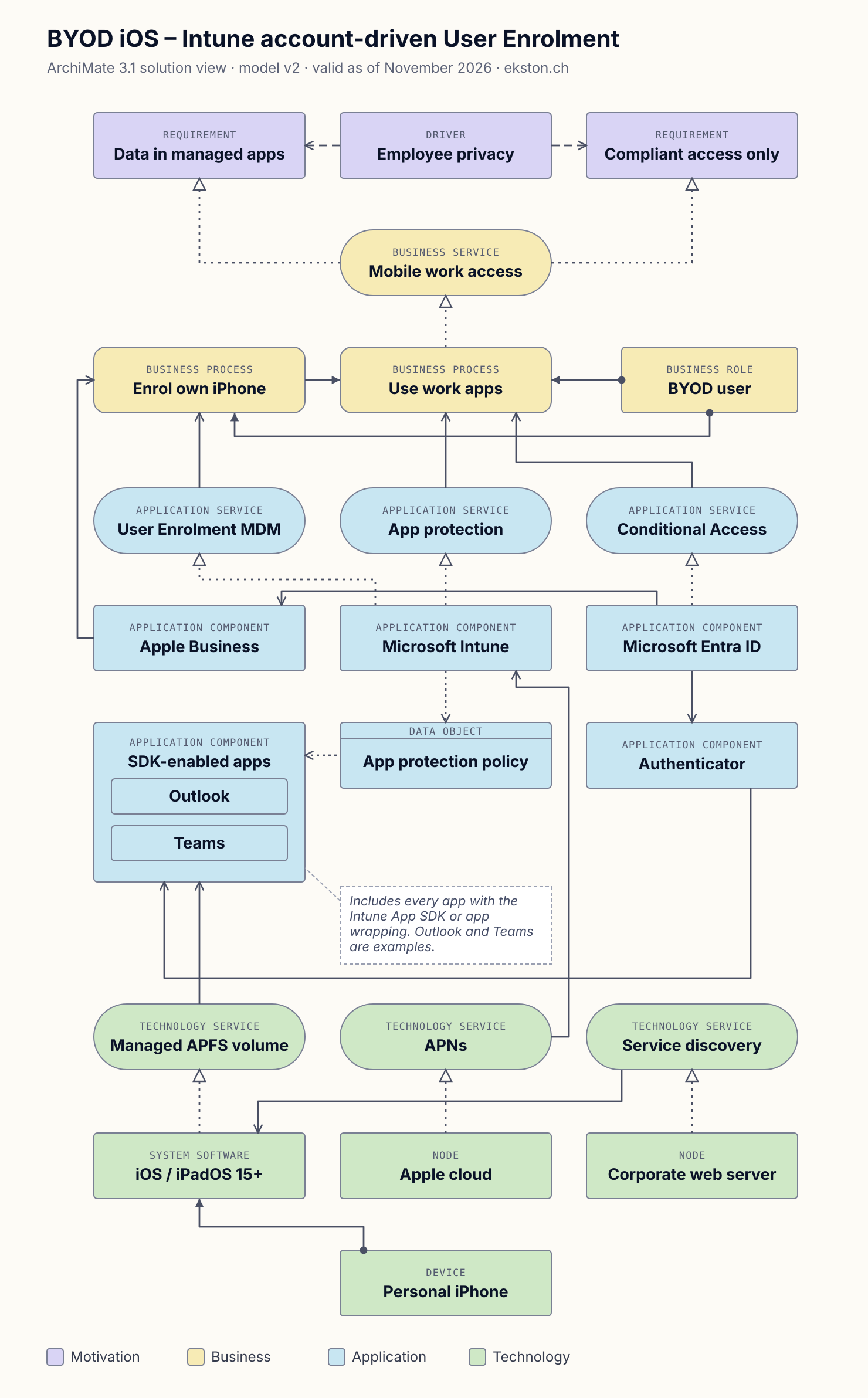
iOS: account-driven User Enrolment. Click to enlarge.
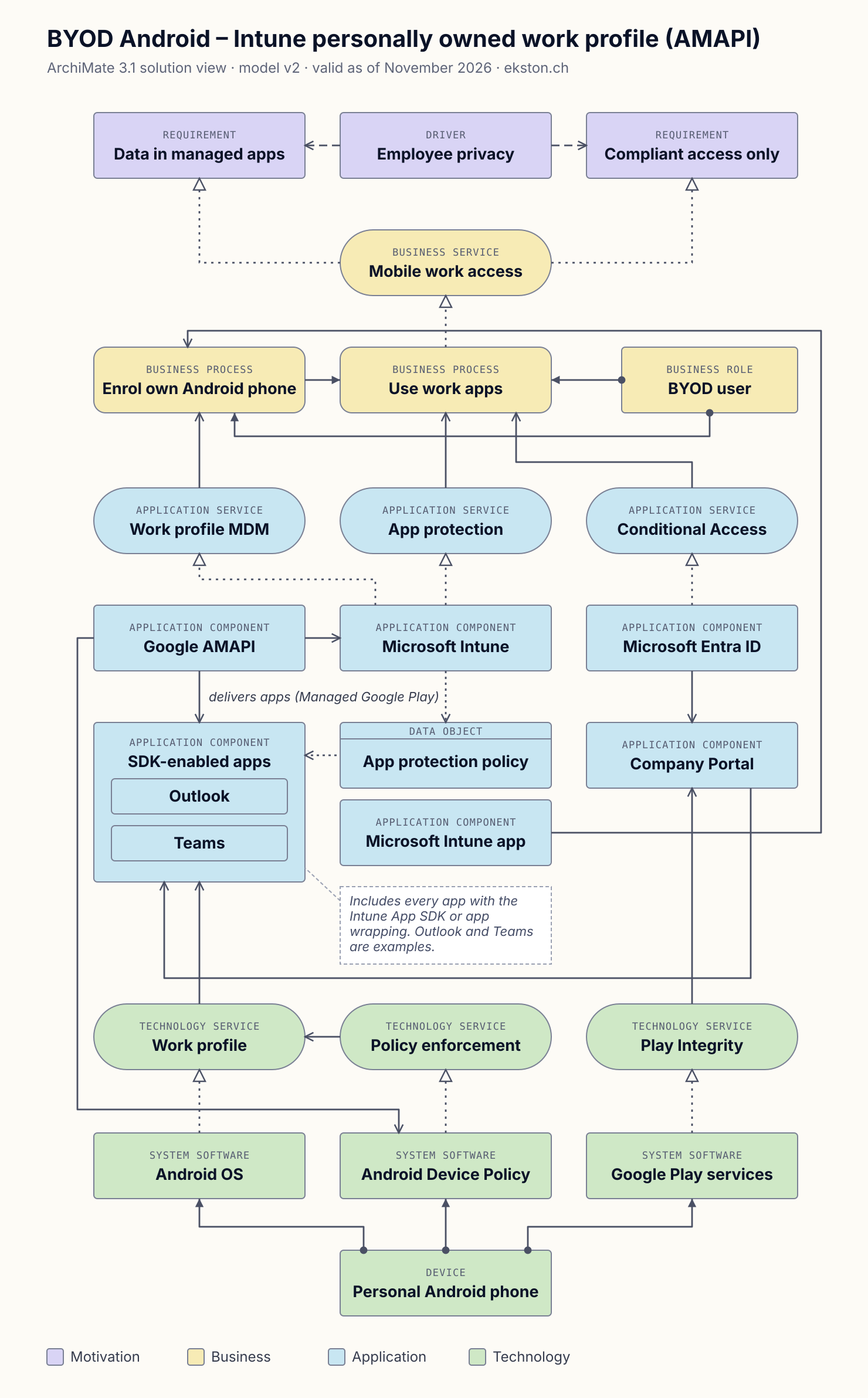
Android: personally owned work profile on Android Management API. Click to enlarge.
How to read the arrows:
| Line | Relationship | Meaning here |
|---|---|---|
| Solid, open arrowhead | Serving | One thing is used by another |
| Dotted, hollow triangle | Realisation | A component delivers a service |
| Dotted, small arrowhead | Access | Reads or writes the policy |
| Solid, filled arrowhead | Triggering | Enrolment comes before using work apps |
| Dot at the start | Assignment | The user role, or the phone running its software |
| Dashed | Influence | The driver shapes the requirements |
Download the model
Download the ArchiMate model (Open Exchange Format, version 2)
In Archi: File › Import › Open Exchange XML Model. The model has 37 elements, 48 relationships, and both views.
Known weak spots
I took a few shortcuts on purpose. ArchiMate purists will spot them anyway, so here they are:
- Application components realise application services directly. Strictly, that’s a derived relationship and a function should sit in between.
- Components, not functions, read and write the app protection policy.
- “Policy enforcement serving Work profile” is semantically weak.
- App delivery is modelled on Android (Managed Google Play) but not on iOS.
- On Android, Intune also installs Microsoft Authenticator for single sign-on.2 The Android view doesn’t show it yet.
If you’d model something differently, I’d like to hear it.
Changelog
| Date | Change |
|---|---|
| 20 Nov 2026 | Version 2, first published. Both views use the same layout; Apple Business serves the iPhone enrolment; the Microsoft Intune app is added on Android. |
Microsoft Learn, Set up account driven Apple User Enrollment. ↩︎
Microsoft Learn, Use Android Management API for personally owned devices with work profiles. ↩︎ ↩︎