
Who's Driving?

My use of AI at work and at home has gone in different directions. Notes on an untidy personal publishing setup, a maturity model I wrote in 2015, and why I'd like to be the driver and not the human in the loop.

On learning to work with AI, and wondering now and then whether I’ve built myself another problem.
I recently asked Microsoft Copilot to accept a series of meeting invitations in Outlook. It didn’t manage. That’s mildly annoying on a normal day. It’s more annoying when I’ve spent the previous evening using AI to research an article, challenge its arguments, create illustrations, and change a website. Apparently the meeting invitations are the hard part.
I know why. Corporate environments come with permissions, policies, and restrictions, and generating content is a different job from reliably executing actions in business applications. I work in enterprise IT, so I could give you the long explanation of why something that looks simple isn’t. I still want my invitations accepted.
The episode shows something I’ve noticed over the past months. My use of AI at work and at home has gone in different directions. At work there’s Microsoft 365 Copilot for everyday tasks, and custom AI solutions where special models or hosting requirements make sense. It’s a world of managed services and deliberate decisions about what the technology is allowed to do. At home I’ve collected a handful of AI tools that help me run this blog. I can experiment, connect things, drop them again, and break something without explaining it to a change advisory board.
The home setup isn’t more productive every day, but it has become the more interesting of the two.
An untidy publishing operation
I started with AI like everyone else: ask a question, get an answer, improve a paragraph. That’s still a good part of what I do, but some of it has grown.
Take the Weekend Reader. During the week I come across articles worth sharing. Grok bots store the links and put the material together when the next edition is due. It sounds nicely automated until you remember that somebody still has to read the stuff and decide what’s worth passing on. A collection of links isn’t an editorial opinion, although a good part of the internet seems to disagree.
Longer articles take weeks. I research, follow references, change my mind about the angle, and rewrite sections that no longer fit. Claude is my usual companion for that. When I suspect I’ve grown too attached to my own reasoning, I take the argument to ChatGPT, which I also use for illustrations and sometimes for a first draft. The division of labour is hardly scientific. Sometimes I use whichever tool is open, and sometimes I ask two models to look at the same problem.1
More and more of the work isn’t writing at all. It’s interactive architecture diagrams, the structure of the site, Hugo templates, and code in GitHub.
And because several AI projects are now involved, I’ve set up a shared content tracker in Notion so they at least agree on which articles exist and what state they’re in. It has status definitions, owners, and rules about who may change what. I escaped the change advisory board and then built one for my assistants.
Pick a route below to see how a piece travels through this setup.
Swipe sideways to see the whole map.
One straight road at work. At home, a network of stops with roads leading back.
Tap a stop to see who does what there.
Something I wrote eleven years ago
All this reminded me of a post from 2015, The Büchler Maturity Model. The title was a bit presumptuous on purpose. I even added a footnote asking readers to point me to an existing model that said the same thing.
The argument was that technologies and practices move through phases. First comes exploration, when doing anything useful takes real expertise. Then commoditisation makes the capability available to almost everyone. The third phase was the one I found most interesting, professionalisation. The tools are easy to get and easy to use, but producing results of acceptable quality gets harder again, because expectations rise.
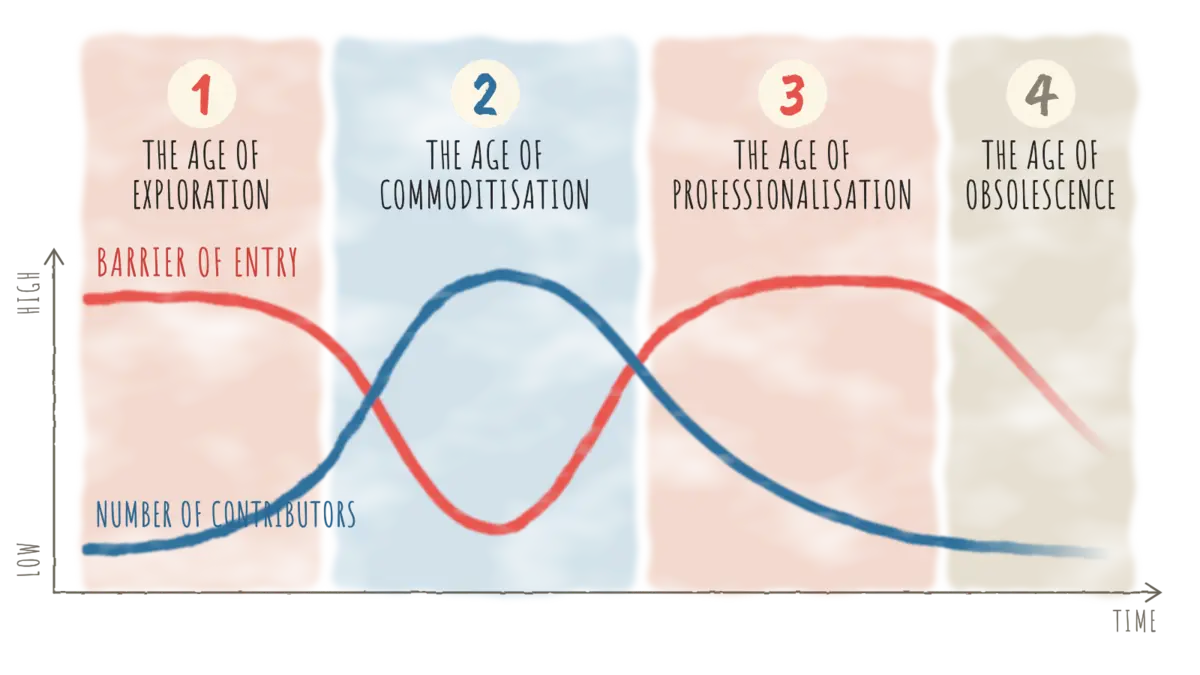
My example was blogging. Publishing a website once took technical knowledge most people didn’t have. Blogger, WordPress, and similar tools removed that hurdle, and suddenly everyone could publish. That didn’t mean everyone had something to say. I also noted that most people never professionalised at all. They moved on to social networks, where the barrier stayed low and the job became finding the gems in the noise.
Generative AI is going through the same thing, only much faster. A plausible article, illustration, or website prototype is now easy to produce. A good one is another matter.
I wouldn’t place AI as a whole in one of the four phases, because different uses move at different speeds. But I can place my own corner of it. AI-assisted publishing is deep in commoditisation, and the untidy operation described above is my attempt at professionalising. If blogging is any guide, most use will stay where the barrier is low, and that’s fine.
What I hadn’t thought about in 2015 is what proficiency would look like. Here it means directing several capable tools that all contribute to the same piece of work.
Human in the loop
That expression usually describes human oversight of an automated process. Someone reviews the output, checks whether an action is appropriate, and approves the next step. All sensible. But it sounds passive to me, as if the machine has already decided where we’re going and I’m standing beside the road with a clipboard. I’d prefer to be driving.
When I research an article, I decide which questions deserve more digging. If an AI produces an argument that sounds convincing, it’s on me to check whether the evidence supports it, and to notice when a beautifully done illustration misses the point. And when a model happily offers five more improvements to something that was already good enough, I need to tell it to stop.
This post is a fair example. I gave ChatGPT the angles I wanted covered, and it wrote the first draft. Claude reviewed it, told me the title promised a different article, and rewrote it. I checked the claims about my own life, cut what didn’t sound like me, and decided it was ready. Whether that’s driving or sitting in a very comfortable back seat, I’ll let you judge.
I’m trying to practise these skills on purpose. I want to check sources without turning every small question into a research project, notice when a second perspective would help, and delegate work without delegating responsibility. In time I’d like it to become muscle memory. An experienced driver makes dozens of small decisions without thinking about how to operate the car, and still pays attention to the road. That’s roughly where I’d like to get with AI, although right now I have several vehicles, they all handle differently, and somebody keeps moving the controls.
There’s another complication. The tools are so helpful, and playing with them is so entertaining, that I can spend an evening improving the machinery without writing a line. First it’s a bot for the links, then better summaries, then a tracker, then an adjustment to the website. In Climbing in Place I wrote about the difference between technological activity and actual progress, and it applies to my own experiments more than I’d like. I enjoy building these workflows, which doesn’t make them worthwhile.
On the other hand, some things would never have got past a note without AI. The interactive diagrams are a good example. I can explore an idea, see a working version, find out what doesn’t work, and try again, without having to learn how to code first. So the test I use is whether I’m doing things I couldn’t reasonably have done before, or just finding more elaborate ways to do what I already did. I haven’t worked out the answer yet.
If I ever get all these tools to work together reliably, I’ll ask them to sort out my Outlook invitations.