
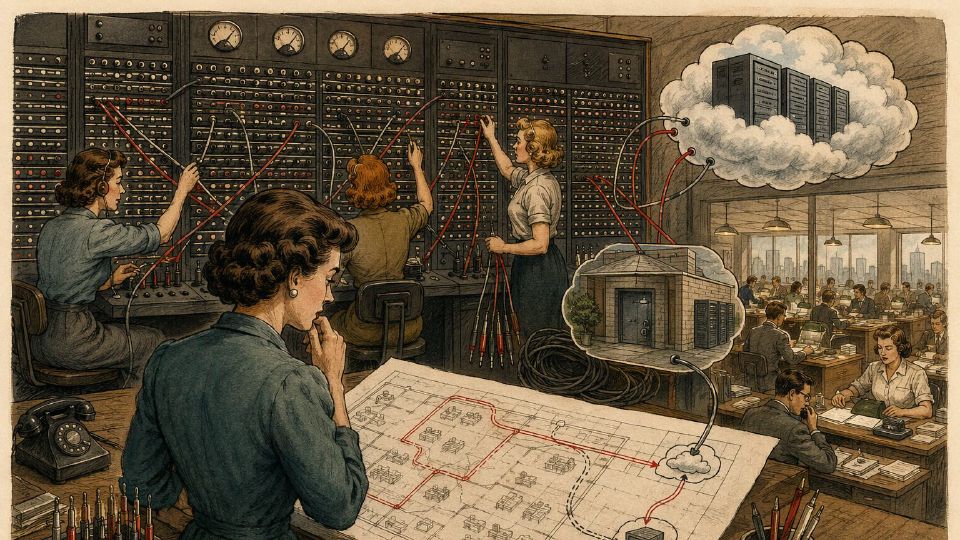
Sovereign Workplace framework
The long version: why now, the four dependencies in detail, how much and where, how far you can split, and how to start, for an estate that runs on Microsoft 365.
You will keep depending on providers. The work is deciding which dependencies to accept, which to reduce, which to prepare to unwind, and where to stop.
Last reviewed 23 November 2026Changelog
An ounce of prevention is worth a pound of cure.
You depend on a provider in four ways. Each is a separate problem.
Per sensitivity level, in the estate you have
The provider can read it
Provider staff or a foreign authority could reach your content.
Lever: own keys, data placement
The provider holds the only usable copy
If the service goes, your data goes with it.
Lever: independent backup and archive
Touch how the whole workplace runs
The provider must operate it
It works only while they keep running it for you.
Lever: local or partner operation, a second channel
You can't work without their technology
Even if someone else ran it, it would still be their software.
Lever: substitution, open standards
The left pair is usually the cheaper place to start. A measure that reduces one dependency can leave the others untouched.
More in The four dependencies in detail.
For each dependency that matters, one of four answers fits.
a dependency that matters
Implement
Change the architecture now. The consequence and the cost justify it.
You leave with: a change and its owner
Prepare
Don’t separate yet. Keep the option open and avoid new coupling.
You leave with: a guardrail for new projects, to avoid more coupling
Document
Accept the dependency, and record why.
You leave with: a decision record, an owner, a reason to revisit
Stop
Go no deeper. More independence would cost more than the risk, or duplicate parts of the workplace you have.
You leave with: a stated limit
Four answers, not four levels. Most organisations end up with all of them, for different dependencies and different data.
A decision record can be as light as an Architecture Decision Record.1 Which outcome fits depends on what happens if the dependency fails, whether you can draw a boundary around it, what separating it costs, and what acting now keeps open. How much, and where works through these four questions; How far you can split shows where separation can stop.
One question tests your answers:
You lose access for 30 days because the provider can’t or won’t serve you any more. What still works?
A good answer doesn’t need everything to keep running. It needs you to know in advance which few processes and channels must, and to have tested them. The framework helps you get to that answer, so that the dependencies you live with are decisions rather than accidents.
The framework is the long version. The map and the model let you work through your own estate; both are proposals for discussion, not measurements.
The long version: why now, the four dependencies in detail, how much and where, how far you can split, and how to start, for an estate that runs on Microsoft 365.
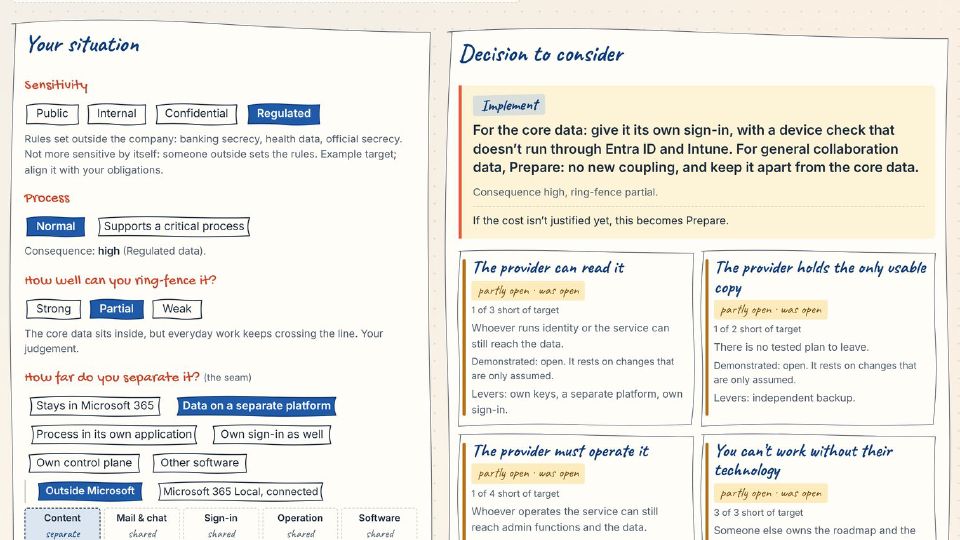
Pick a sensitivity level and criticality, try the levers, and see which dependencies move and what it costs.
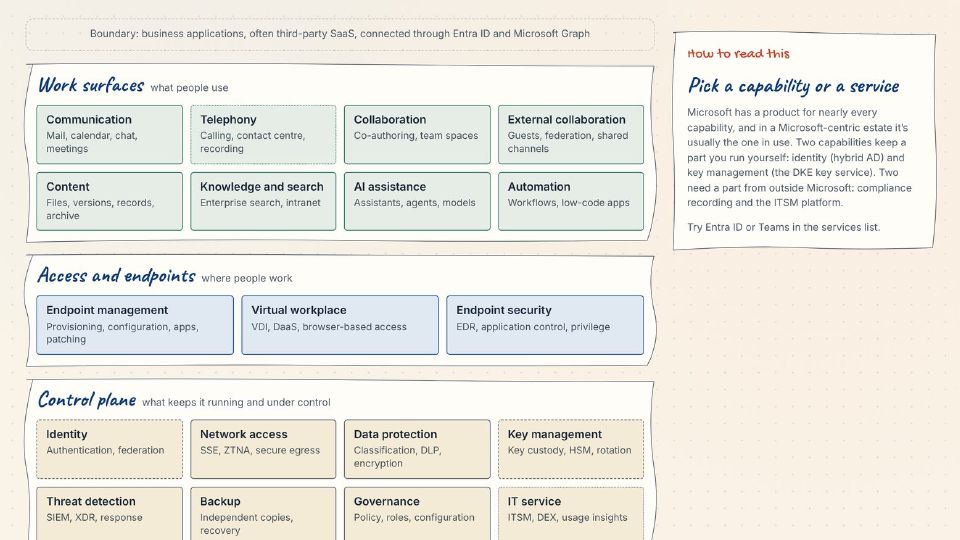
What a digital workplace has to deliver, in three layers, without naming products. An interactive version adds a Microsoft view and three lenses.
Shorter pieces that test the framework from one angle each. They stand alone.

For an organisation already on Microsoft 365, I can't justify a Linux desktop on sovereignty grounds alone. For technical teams there's a good case, and a few developments could change my answer.

Business continuity plans assume the provider is working to bring you back. On Day 2 it isn't, and the tools you'd use to respond sit in the platform you've lost.

Third-party patching tools are tier-0 assets. A look at the permissions they ask for, and the ones I wouldn't grant.
Storm-0558 stole the stamp that signs identity tokens. Double Key Encryption releases its key to any valid token, so it protects files in Microsoft's storage, but not against the identity provider that issues the tokens.
Michael Nygard, Documenting Architecture Decisions (15 Nov 2011), the post that introduced the format. ↩︎